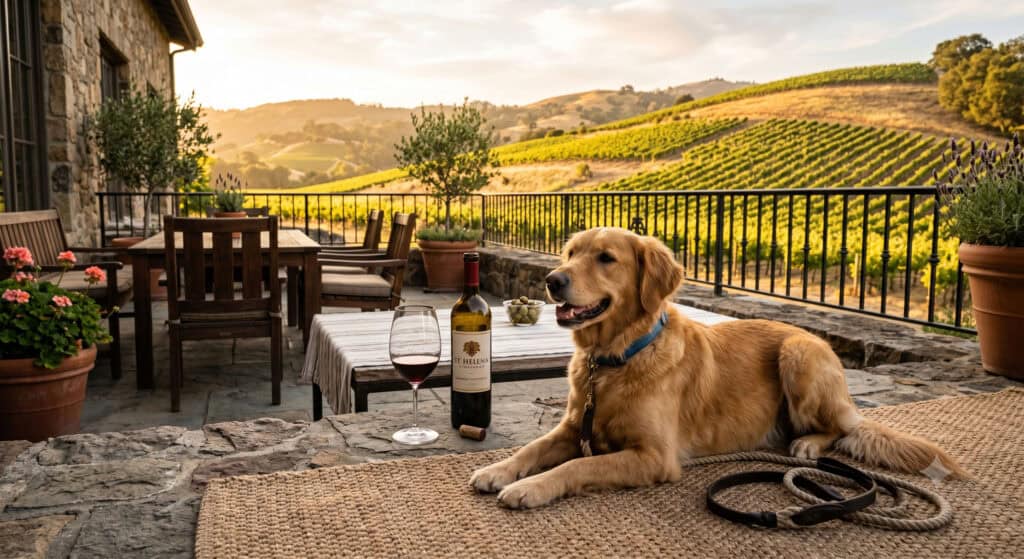
Somewhere between your second glass of Cabernet and the moment the staff brings out a plate of dog-safe treats, you realize you’ve been making a mistake leaving your pup at home. Dog friendly wineries in Napa Valley are more common than most visitors realize — at least 19 by current count, ranging from a working horse ranch with an actual off-leash dog park to a Carneros tasting room that hand-prepares barkuterie boards for canine guests. Here’s where to go, what to expect at each stop, and how to plan a day that works for both of you.
Why Napa Valley Works So Well for Dogs
Napa’s wine culture leans heavily outdoor. Most tasting experiences happen on shaded patios, in vineyard gardens, and around reflecting pools — which turns out to be excellent news for dogs. Cave tours and formal indoor tastings are generally off-limits, but the outdoor experiences that welcome pets are often the most relaxed and scenic ones anyway: long, unhurried afternoons on beautiful grounds with wine in your glass and your dog stretched out at your feet.
The valley’s dog-friendly scene has grown considerably over the past few years. Several wineries have moved well beyond simply tolerating leashed pets and now actively invest in the experience — water bowls at every table, dedicated dog treats, and in at least one case, a full off-leash dog park. Visit Napa Valley tracks the official pet-friendly list, which grows each season. Whether you’re a first-timer or a regular who’s never thought to bring your dog along, the options are genuinely better than you’d expect.
The Best Dog-Friendly Wineries in Napa Valley
These four wineries go furthest in welcoming dogs — not just with a policy on paper, but with outdoor tasting areas designed with pets in mind and staff who are genuinely enthusiastic about four-legged guests. Each one has something specific that sets it apart from a generic “leashed pets tolerated” situation.
Alpha Omega — Rutherford’s Most Welcoming Outdoor Experience
Leashed dogs are welcome on the outdoor patio at Alpha Omega Winery in Rutherford, and the setting is one of the valley’s more memorable places to spend an afternoon. The winery is built around a reflecting pool with five fountains, and the covered patio overlooking it strikes exactly the right balance between relaxed and impressive. Alpha Omega focuses on Bordeaux-style reds and Chardonnays sourced from top appellations across the valley, and the wine is strong enough that tasting fees — ranging from $75 to $125 per person — feel earned rather than extortionate.
Book in advance, especially on weekends, when the patio fills quickly. Multiple guests have noted in reviews that the staff isn’t just policy-compliant about dogs — they’re legitimately happy to meet them. Alpha Omega is celebrating its 20th anniversary in 2026, and it remains one of the most hospitable operations in the valley, for humans and dogs alike.
Pine Ridge Vineyards — Garden Tastings on the Silverado Trail
Located in the prestigious Stags Leap District along the Silverado Trail, Pine Ridge Vineyards has a shaded garden and terrace area where dogs are welcome on leash. The setting delivers: terraced vineyards, dramatic ridgeline views through the pines, and dappled afternoon light that makes everything look better than it has any right to. Water bowls come out without being asked.
For a dog-friendly visit, the garden experience is your best option. Pine Ridge offers a “Bottle Service and Picnic in the Garden” format — 90 minutes of private outdoor seating with a two-bottle minimum — that works well if you want to bring food from downtown, give your dog room to settle in, and take your time without being rushed through a structured flight. Reservations are required and fill quickly on weekends; book a few days out. One hard rule applies: dogs aren’t allowed in Pine Ridge’s wine cave experiences. Plan for the garden and you’ll have no surprises.
Tamber Bey Vineyards — Where Your Dog Can Actually Run Free
Tamber Bey is in a different category from almost every other winery on this list. The tasting room sits on Sundance Ranch, a working 22-acre equestrian facility in Calistoga — the only winery in Napa Valley set on a full horse ranch. Leashed dogs are welcome in the outdoor tasting courtyard, and the property also has a dedicated off-leash dog park where your pup can run and stretch while you work through the flight. This isn’t a figurative amenity — it’s an actual fenced area specifically for visiting dogs.
Walk the paddock-lined driveway on arrival and your dog will smell the horses before you see them: Arabians, polo ponies, miniature horses, and Mustangs, among others. Staff keeps water ready for dogs and provides a savory treat that’s safe to share. The wine is serious and Cabernet-focused — the Calistoga appellation produces structured, cellar-worthy reds — and the Courtyard tasting runs around $100 per person. Reservations are required; mention you’re bringing a dog when you book so they can ensure appropriate outdoor seating. If you’re choosing one Napa winery specifically for your dog, this is the one.
Migration Winery — Where Your Dog Gets a Barkuterie Board
Migration Winery, in the Carneros region at the southern end of Napa Valley, has built a genuine reputation for treating dogs like actual guests rather than an afterthought. The tasting space is a greenhouse-style indoor/outdoor setup — bright, cool, and comfortable — and dogs are welcome in the outdoor sections on leash. The staff is warmly enthusiastic about canine visitors, which helps set the tone. The real draw, though, is the barkuterie board: a house-prepared plate of dog-safe treats that Migration will bring to your table while you work through your Chardonnay and Pinot Noir flight. The concept is either endearing or over the top depending on your tolerance, but the dogs seem uniformly enthusiastic.
The wines are worth your attention on their own merits, especially the Pinot Noir. Migration is a casual, social stop that works well as an opener or a closer on a dog-friendly Napa day — the vibe is relaxed rather than formal, which most dogs seem to prefer anyway.
More Dog-Friendly Stops Worth Adding to Your Itinerary
Beyond those four, Napa has a solid supporting cast of dog-welcoming tasting rooms. None require the kind of advance planning a Tamber Bey reservation does, but a quick call ahead is smart at all of them.
Frog’s Leap Winery (Rutherford) runs its garden tasting out of a relaxed English-style Garden Bar. Dogs are welcome leashed, the winery’s own dog Silvia roams the grounds, and Frog’s Leap still allows walk-ins to the garden — a genuine rarity in modern Napa. Farming is organic and dry, wines lean toward Sauvignon Blanc and Cabernet, and the whole operation has an unhurried quality that dogs tend to appreciate as much as their owners do.
Paraduxx (Duckhorn Collection, Silverado Trail) takes dog hospitality seriously: dog beds come out in the courtyard, water bowls are ready, and they offer a $10 barkuterie plate that has become something of a dog-day ritual for regulars. Worth a half-hour stop if you’re already making the Silverado Trail run.
Honig Vineyard & Winery (Rutherford) sums up its dog policy concisely: “We’re dog-friendly as long as your dog is friendly.” Fair trade. The winery is focused on Sauvignon Blanc and Cabernet Sauvignon and committed to sustainable farming. One nice touch: Honig uses trained Golden Retriever sniffer dogs on the vineyard to detect vine mealybugs, so your dog may meet a working colleague on the grounds.
Tres Sabores Winery (St. Helena) greets visitors with a pack of resident golden retrievers, which tells you most of what you need to know. Dogs are genuinely welcome, but Tres Sabores requires advance reservations for all guests — dogs explicitly included in that policy. Call before you go.
New in 2026: The Yount Room
One new Yountville destination worth flagging is The Yount Room, which had its grand opening in February 2026 inside the historic Yountville Station — a building that’s been part of the town’s story since the late 1800s, serving as a train depot, post office, and bar before its latest reinvention as a collective tasting room. The interior has a cathedral-style wood-beam ceiling and walls lined with historical photographs. The format is casual and walk-in friendly rather than formal seated appointments, and it pours wines from Cornerstone Cellars, Conn Creek, Cain, and a rotating roster of boutique producers. There’s an outdoor patio on Washington Street worth knowing about.
Whether the patio accommodates dogs is worth confirming before you arrive — their dog policy isn’t widely documented this early in their run. Call (707) 945-0388 or check current Yelp listings first. It’s a genuinely interesting new addition to Yountville regardless, and a convenient stop if you’re already in the village for the afternoon. If you’re staying for dinner, our guide to Yountville’s best restaurants covers everything from The French Laundry down to casual weeknight spots.
Tips for Planning a Dog-Friendly Wine Day in Napa
Always call ahead, even at officially dog-friendly wineries. Outdoor seating is limited, policies evolve, and busy weekends can change the calculus. A 30-second call before you go is faster than troubleshooting on arrival.
Book weekday appointments when you can. Summer weekends in Napa get genuinely crowded — more foot traffic, less room for dogs to settle, and more strangers walking up unannounced. A Tuesday or Wednesday visit is a calmer, more enjoyable experience for most dogs. Our season-by-season guide to Napa Valley timing covers what to expect each month, including the summer heat curve that matters for dogs.
Skip cave tours on dog days. Nearly every Napa winery with cave tastings prohibits dogs in them. Plan for all-outdoor experiences on dog days and you’ll avoid the awkward mid-tour handoff situation.
Bring your own water supply. Most dog-friendly wineries provide water bowls, but dogs drink more when they’re warm and active. A collapsible bowl and a water bottle in your bag weighs nothing and solves the one problem that’s annoying to troubleshoot mid-tasting.
Keep the day to two or three stops. Build in walk time between wineries — there are good road shoulders and trail access throughout the valley, and a 20-minute stretch between stops keeps your dog (and honestly, you) in better shape than a rushed four-winery sprint. Our first-time Napa Valley itinerary has a pacing template worth borrowing. For managing tasting fees across a multi-stop day without blowing the budget, the Napa on a budget guide has practical strategies.
Frequently Asked Questions About Dog-Friendly Wineries in Napa Valley
Are most Napa Valley wineries dog-friendly?
Not all of them, but more than most visitors realize. There are at least 19 confirmed dog-friendly wineries in Napa Valley, and the list continues to grow. Most require dogs to be leashed and restrict pet access to outdoor areas — caves and formal indoor tastings are almost universally off-limits. The range of welcome runs from “technically permitted” to “we have dog beds and barkuterie boards ready.” Calling ahead before any visit is the safest approach.
Do I need a reservation to bring my dog to a Napa winery?
Yes, at most dog-friendly wineries. Even places that openly welcome dogs — Pine Ridge, Tamber Bey, Alpha Omega — have limited outdoor seating that fills quickly on weekends. Booking in advance and noting that you’re bringing a dog when you reserve ensures they’ll have appropriate outdoor space ready. Tamber Bey specifically asks that you mention your dog at the time of booking.
What is a barkuterie board?
A barkuterie board is a dog-safe version of a charcuterie plate — a curated selection of treats prepared specifically for canine guests while their owners are tasting wine. Migration Winery and Paraduxx (Duckhorn Collection) are the best-known spots for these in Napa Valley. The boards typically include plain proteins, vegetables, and dog-safe nibbles. Whether you find the concept charming or excessive, the dogs seem universally on board with it.
Can dogs go into wine caves at Napa Valley wineries?
Almost never. Cave tastings are climate-controlled, narrow, and often shared with other guests — and nearly all Napa wineries prohibit dogs in the caves regardless of how dog-welcoming the outdoor experience is. Pine Ridge, for example, is enthusiastically dog-friendly in the garden but clearly excludes pets from cave tours. If cave tastings are a priority for your trip, plan a separate day for those, or come with someone who can wait outside with your dog during that portion.
What should I bring when wine tasting with my dog in Napa?
A leash (required everywhere), a collapsible water bowl, enough water for your dog, waste bags, and anything your dog needs to stay comfortable in the heat. Summer afternoons in Napa regularly push into the 90s. Timing your tasting stops for morning or late afternoon — rather than peak midday heat — makes the day significantly more comfortable for a dog. A cooling mat in the car between stops also helps.
Napa doesn’t have to be a leave-the-dog-at-home kind of trip. The valley has more options for dogs than most people realize, and the wineries that are genuinely committed to the experience — Tamber Bey’s horse ranch most of all, but Pine Ridge’s garden sessions and Migration’s barkuterie boards are close behind — make it easy to pull off a full, enjoyable day. Keep it to two or three stops, call ahead, build in walk time between visits. Your dog will approve of the arrangement considerably more than they ever approved of being left behind.