Ask most people what Napa Valley is famous for and you’ll get one answer: Cabernet. But drive twenty minutes south to Carneros on a warm afternoon and you’ll find a different crowd, one clinking flutes of crisp, bone-dry sparkling wine instead of swirling big reds. Napa Valley sparkling wine has quietly become one of the best reasons to visit wine country, especially if you want a tasting that feels like a celebration rather than a lecture on tannins. I’ve worked my way through Carneros and up-valley more times than I can count, and these five wineries are the ones I keep sending friends back to.
A quick note before we get into it: méthode traditionnelle, the same labor-intensive, bottle-fermented process used in Champagne, is what separates these five from a basic winery pour — and it’s worth knowing before you taste.
Napa Valley Sparkling Wine 101: Why Carneros Leads the Way
Carneros sits at the southern end of Napa Valley, close enough to San Francisco Bay that morning fog rolls in most days and doesn’t burn off until mid-morning. That cool, foggy stretch is exactly what Chardonnay, Pinot Noir, and Pinot Meunier — the three grapes behind traditional-method sparkling wine — need to develop the bright acidity that makes a good bubbly worth drinking. It’s the same logic that makes Champagne, France, and Carneros, California, unlikely cousins.
Not every winery on this list sits in Carneros, though. A couple are up-valley in Calistoga and Yountville, chosen because their sparkling programs are strong enough to justify the drive. If you care as much about the building as the bottle, several of these estates, particularly the château-style properties, also show up on our guide to the most beautiful wineries in Napa Valley.
Domaine Carneros: Château Views and Taittinger Pedigree
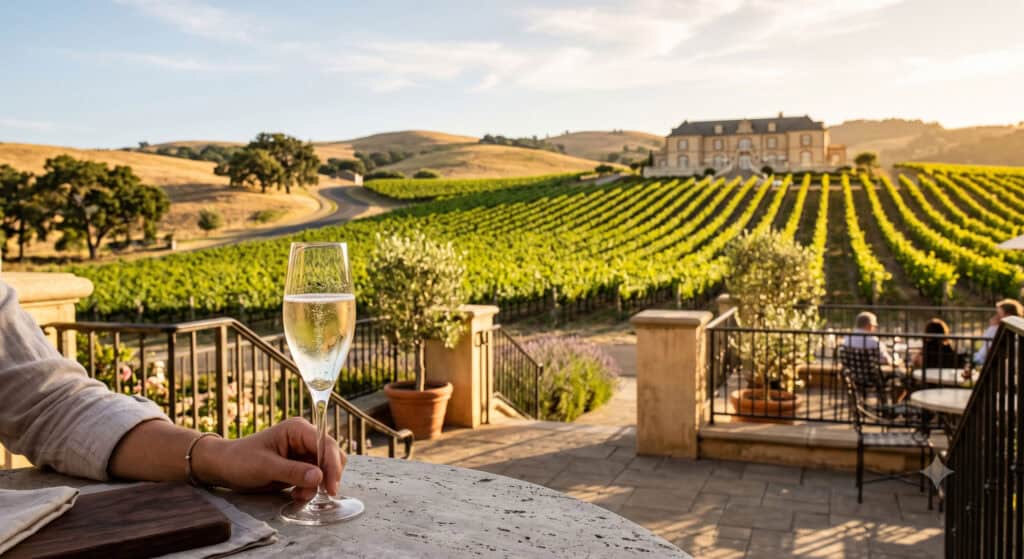
Domaine Carneros is the winery that made me a sparkling wine convert. The estate is 50% owned by the Taittinger family — yes, the Champagne Taittingers — and the château itself is modeled after Taittinger’s own Château de la Marquetterie in France, right down to the terrace where you can sip a glass of Brut Rosé while looking out over the vines. Unlike a lot of Napa wineries that treat sparkling wine as an afterthought, Domaine Carneros builds its entire identity around it, with a lineup that runs from a bone-dry Blanc de Blancs to a lush, berry-forward Brut Rosé.
Reservations are required and open up to 60 days out, with tastings running daily from 10 a.m. to 5:30 p.m. (last reservation at 5 p.m., earlier in winter). Weekends book up fast, so grab a slot as soon as your travel dates are set. If you’re planning this as part of a bigger celebration, anniversary, engagement, just because, it’s also one of the stops we build into our romantic couples weekend in Napa Valley itinerary.
Mumm Napa: New Ownership, Same Bubbly Confidence
Mumm Napa just went through the biggest change in its history: after decades under French spirits giant Pernod Ricard, the winery — along with the Mumm Napa and DVX brands — was sold to Trinchero Family Wine & Spirits, the Napa Valley company behind Sutter Home. The deal closed earlier this year, which means Mumm Napa is family-owned for the first time in decades. Worth noting: the sale didn’t touch the actual G.H. Mumm Champagne house in France — that’s a separate business entirely.
For visitors, the tasting experience hasn’t skipped a beat. Mumm Napa is still one of the easiest, most approachable sparkling stops in the valley: flights that let you compare a straightforward Brut against something more distinctive, a patio that’s genuinely pleasant to linger on, and a staff that’s used to guests who’ve never tried a méthode traditionnelle wine before. It’s a smart first stop if bubbly is new territory for you.
Schramsberg Vineyards: Cave Tours and the Wine That Toasted Peace
If Domaine Carneros is the château experience, Schramsberg is the history lesson — and one of the better cave tours in Napa Valley. The estate’s hillside caves, carved into the mountainside more than a century ago, are cool, dim, and stacked with hundreds of thousands of bottles aging on their sides. It’s a genuinely different way to spend an hour compared to a standard tasting room pour.
Here’s the trivia that makes Schramsberg worth knowing: their 1969 Blanc de Blancs was the wine President Nixon and Premier Zhou Enlai raised in Beijing during the 1972 “Toast to Peace” — the first time an American wine had been served at a state dinner of that stature. Schramsberg still leans into that legacy, and their current Blanc de Blancs remains one of the most respected traditional-method bottlings in the country. Most experiences here are by appointment only, and cave tour slots are limited, so book earlier than you think you need to, especially for a specific weekend time.
CHANDON: French Roots, Yountville Polish
CHANDON — most people still call it Domaine Chandon out of habit — has been in Yountville since Moët et Chandon planted the first vines back in 1973, making it the valley’s original French-owned sparkling house. Where Domaine Carneros leans formal and Schramsberg leans historic, CHANDON leans social: a wide range of sparkling styles, a genuinely good food program, and a setting built for lingering over a full afternoon rather than a quick pour.
That range is the real selling point. You can taste a crisp Brut, a richer Blanc de Noirs, and a still Pinot Noir all in the same visit, which makes CHANDON a good choice if your group has mixed preferences (read: someone in your party who insists they “don’t really like sparkling wine” — this is where you prove them wrong). Tastings run by reservation with occasional walk-in availability, and winter hours can shift, so check the week you’re going.
Frank Family Vineyards: Calistoga’s Sparkling Secret
Frank Family Vineyards gets talked about for its Cabernet and Chardonnay, but the sparkling program is arguably the better story, and most visitors have no idea it exists until they’re standing in the tasting room. The estate sits on Larkmead Lane, on land that was originally the historic Larkmead Winery, established in 1884 and later home to Hanns Kornell, who introduced the traditional méthode champenoise process to California. That sparkling heritage never went away; every tasting at Frank Family still opens with a pour of house-made bubbly before you get anywhere near the reds.
The Blanc de Blancs is the one to ask for: bright, citrus-driven, and aged on the lees long enough to pick up real texture. Frank Family also produces a Brut, a Brut Rosé, and occasional small-lot releases, so there’s more range here than the winery gets credit for. The tasting room itself is a converted Craftsman house in Calistoga, intimate enough that you’ll likely end up chatting with whoever’s pouring. If you’d rather not drive between up-valley stops yourself, a guided outing is worth considering — see our roundup of the best Napa Valley wine tours for driver-inclusive options.
Planning Your Napa Valley Sparkling Wine Day
Trying to hit all five in one day is possible but rushed, and I’d rather you enjoy the wine than sprint between parking lots. A Carneros-focused morning (Domaine Carneros, maybe paired with lunch in downtown Napa) works well as a half-day. If you’re staying up-valley, pair Schramsberg’s cave tour with Frank Family in the same Calistoga afternoon, since they’re a five-minute drive apart. Mumm Napa and CHANDON sit closer to the middle of the valley and pair naturally with a Yountville dinner reservation.
A few practical notes that’ll save you a headache: nearly every winery on this list requires a reservation now, not just a suggestion, so check our full winery reservations in Napa Valley guide before you build your day. Sparkling tastings are also genuinely better earlier, when your palate is fresh and the bubbles aren’t competing with a heavy lunch. And if you’re budgeting the trip, tasting fees at these five range from moderate to genuinely splurge-worthy — our breakdown of the cost to visit Napa Valley can help you plan around it, and if you want to make a weekend of it, we’ve got a full where to stay in Napa Valley guide with options at every price point.
Frequently Asked Questions About Napa Valley Sparkling Wine
Is Napa Valley known for sparkling wine?
Napa is best known for Cabernet Sauvignon, but the Carneros region at its southern end has a long-standing reputation for high-quality, traditional-method sparkling wine. It’s home to producers like Domaine Carneros, Mumm Napa, and Schramsberg.
What’s the difference between Napa sparkling wine and Champagne?
Both use méthode traditionnelle, a secondary fermentation inside the bottle, but Champagne can legally only come from the Champagne region of France. Napa sparkling wine uses the same grapes and process, reflecting California’s warmer climate with riper, fruitier profiles than their French counterparts.
Do I need a reservation for sparkling wine tastings in Napa Valley?
Yes, in nearly every case. All five wineries in this guide operate on a reservation-first model, especially on weekends and during harvest season from September through October. Book at least a few weeks ahead for a specific time slot.
Which Napa Valley winery has the best cave tour for sparkling wine?
Schramsberg Vineyards. Their century-old hillside caves, where hundreds of thousands of bottles age on their sides, make for one of the more memorable tasting experiences in the valley.
Is Domaine Carneros good for a special occasion?
Yes. Its château setting, terrace views, and sparkling-first menu make it one of the most popular Napa Valley choices for anniversaries, engagements, and other celebrations.
Did Mumm Napa change ownership?
Yes. In 2026, Trinchero Family Wine & Spirits completed its acquisition of the Mumm Napa winery and brand from Pernod Ricard, making it family-owned for the first time in decades. The sale didn’t include the separate G.H. Mumm Champagne house in France.
Bubbly gets treated like an afterthought in a valley built on Cabernet, but spend one afternoon in Carneros with a glass of Blanc de Blancs in hand and you’ll wonder why you waited so long. Book your reservations before you go, start with a sparkling pour instead of ending with one, and let the rest of your itinerary build around it.