
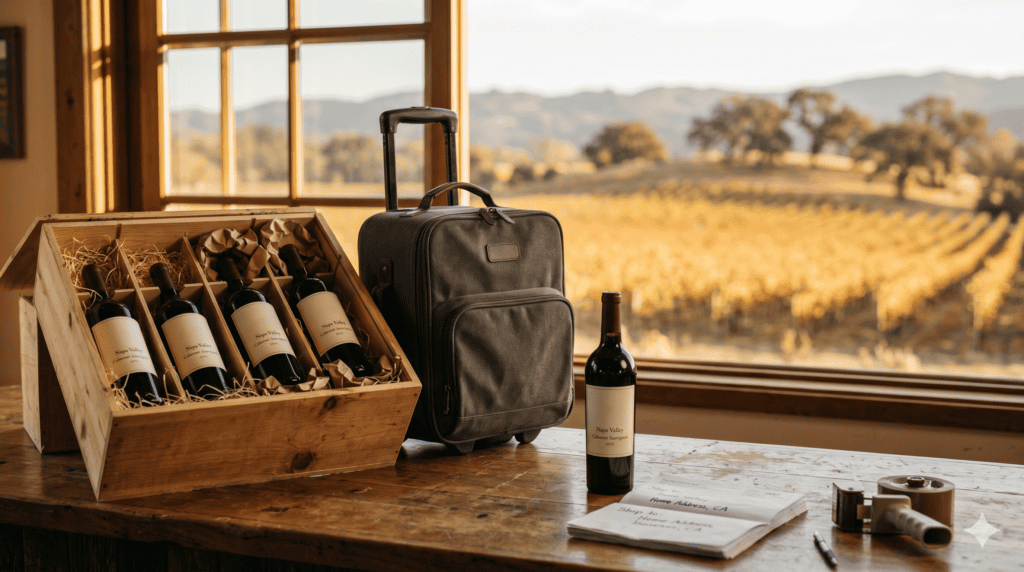
You found the bottle. The one. A Rutherford Cabernet that stopped the tasting room conversation cold, or a boutique Chardonnay you’ve quietly decided is the new house white. Now the only thing standing between you and uncorking it six weeks from now at a dinner party is a little logistics problem: how do you actually ship wine from Napa Valley home without losing it to heat, breakage, or a $90 overweight baggage fee?
Most advice out there is outdated. Free checked bags aren’t a given anymore, airline rules keep shifting, and a lot of shipping options people casually mention (USPS, standard FedEx drop-offs) are flat-out not legal for consumers. Get this wrong and you’re looking at a stained suitcase, a soaked cardboard box on a porch in July, or worse — a package that legally can’t be delivered to your state at all.
This guide walks you through the four real ways to ship wine from Napa Valley in 2026, what each one actually costs, when to pick which, and the packing and legal gotchas that trip up first-timers. By the end, you’ll know exactly how to get your haul home safely.
The Fastest Answer: Best Way to Ship Wine From Napa Valley
If you’re taking home roughly a case (9–12 bottles), the best value for most travelers is a reusable wine travel case checked at the airport. The Wine Check is the most popular option — it’s a rolling padded shell built to enclose a standard 12-bottle winery shipper box. At about 3.3 pounds empty, it keeps a full case under most airlines’ 50-lb weight limit when you pack it carefully.
But it’s not always the right call. If you’re visiting during a summer heat wave, buying from six different wineries, or flying an airline without a generous wine allowance, a licensed Napa wine shipper almost always beats the airport route. Here’s how to match the method to your trip:
- Flying home with 6–12 bottles: Wine travel case as checked baggage
- Buying from multiple wineries: Licensed Napa shipping service (they consolidate)
- Summer or winter extremes: Temperature-controlled shipper (skip the airport)
- Just a few bottles: Bottle sleeves in your suitcase, or let the winery ship
Option 1: Fly Home With Wine as Checked Baggage
Checking wine yourself gives you the most control. You skip multiple winery shipping fees, you don’t have to track deliveries from the road, and your wine gets home when you do — no waiting two weeks for a temperature-held shipment to release.
The catch is that airline baggage rules have gotten stricter, and “wine flies free” deals are now the exception rather than the norm.
Wine travel cases that actually work
A wine travel case is a purpose-built piece of luggage that holds 12 bottles in individual protected compartments, usually with a removable styrofoam or molded insert. The Wine Check is the lightweight leader because the case itself adds only a few pounds to your total weight — critical for staying under the 50-lb airline threshold. Dedicated hard-shell wine suitcases like the VinGardeValise offer better crush protection but weigh more empty, cutting into your bottle allowance.
Whichever you pick, weigh it at your hotel or a local shipping store before leaving for the airport. Overweight charges can run $100–$200 per bag depending on the carrier — enough to wipe out the savings you came for.
Airline-specific rules to check before you fly
Baggage policies vary dramatically by airline, and some have changed recently:
- Alaska Airlines still runs its “Wine Flies Free” program, which lets eligible members check one case of wine at no charge when flying out of qualifying West Coast airports including SFO, OAK, and STS
- Southwest no longer guarantees two free checked bags on all fares — standard fees now apply on many tickets booked after May 28, 2025
- American, United, and Delta all charge standard checked-bag fees with no special wine exceptions
If you’re flying out of SFO, OAK, or Sacramento, Alaska is almost always the move for wine travelers. For more on picking the right airport for your trip, see our full guide to getting to Napa Valley.
Option 2: Let the Winery Ship Your Wine Directly
Most Napa wineries will ship bottles straight to your home — and for small purchases (1–3 bottles) from a single winery, this is often the easiest play. You taste, you point, they pack, the bottles show up at your door a week or two later.
Winery shipping shines when you’re:
- Only taking home a couple of bottles
- Receiving a scheduled wine club allocation anyway
- Traveling carry-on only and can’t check bags
- Buying from one or two wineries total, not a dozen
Why winery shipping isn’t always available
Many wineries pause direct shipping during heat waves (generally late June through September in the Bay Area) and again during cold snaps in the dead of winter. Standard FedEx and UPS ground trucks aren’t temperature-controlled end-to-end, and an unattended porch in 105-degree weather is a wine cellar’s worst nightmare. Rather than risk cooked bottles, responsible wineries will delay shipments or recommend an upgraded service.
The other gotcha is cost. Winery shipping usually runs $25–$60 for a six-pack and $40–$90 for a case, depending on your destination state. If you hit five tasting rooms and buy from three of them, you’re paying that fee three separate times. That’s where Option 3 comes in.
Option 3: Use a Licensed Napa Wine Shipping Service
Here’s a secret most first-time Napa visitors don’t know: you can’t just walk into a UPS Store with a box of wine and ship it home. Individual consumers are prohibited from shipping alcohol through USPS, FedEx, and UPS unless they’re going through a licensed, pre-approved business account.
That’s what Napa’s wine-specific shipping services exist to solve. These licensed shippers pick up bottles from multiple wineries, consolidate everything into one box (or one pallet, if you really went for it), pack it properly, and ship it legally under their carrier agreements.
Trusted Napa wine shipping services
Four well-known options handle the bulk of visitor wine shipments:
- Buffalo’s Shipping Post (Napa): A long-running local favorite known for wine pickup coordination and straightforward packing pricing
- Napa Mail Center: Downtown Napa location offering wine shipping plus pickup options for qualifying shipments
- Bodega Shipping Co. (St. Helena): Free pickups within Napa Valley on qualifying orders, with optional temperature-controlled service
- Stagecoach Express: Wine-focused shipper with insurance options and cold-pack service for summer shipments
Expect consolidated shipping to run roughly $60–$120 for a case to most U.S. states, with add-ons for ice-pack or temperature-controlled service. Ask about “storage hold” options too — several shippers will warehouse your wine and release it when weather in your destination cools off.
If you’re pacing your tastings to build toward a full case, our guide to the best cheap wine tastings in Napa Valley is a good starting point for hitting multiple rooms without blowing the budget.
Option 4: Bottle Sleeves in Your Suitcase (Small Hauls Only)
For 1–4 bottles, you don’t need a specialized solution. Padded bottle sleeves (often sold as WineSkin or similar) are reusable zip-top bags with absorbent material inside — if a bottle breaks, the sleeve contains the spill and protects your clothes. Pack each sleeved bottle in the center of your suitcase surrounded by clothing, and you’ve got serviceable protection for short hauls.
What not to do: don’t just wrap bottles in sweaters and hope for the best. Suitcases get thrown, and a broken bottle in checked luggage means ruined clothes, stained toiletries, and a potential airline hazard report.
Can You Legally Ship Wine to Your State?
Wine shipping laws in the U.S. are notoriously uneven. Some states allow direct-to-consumer shipping from any licensed winery with no limits. Others require permits, cap annual quantities per household, or ban shipments outright. A few states treat wineries and third-party shippers differently, meaning your St. Helena winery might be able to ship but a Napa consolidator can’t — or vice versa.
The laws also shift regularly. Several states updated their direct-to-consumer frameworks in just the past two years.
Your simplest move: ask one question at every tasting room before you buy.
“Can you legally ship to my home address — and if not, who do you recommend locally?”
The Wine Institute maintains a current state-by-state compliance table if you want to check before you travel. Get this answered before you swipe your card for a case you can’t legally receive.
How to Protect Wine From Heat, Cold, and Jostling
Regardless of which shipping method you pick, wine has four enemies in transit: heat, freezing, UV light, and physical shock. A few habits keep bottles safe from tasting room to doorstep:
- Don’t leave bottles in the car: A closed trunk on an 80-degree afternoon can hit 130+ degrees — enough to cook a wine in under an hour
- Carry a soft cooler: Throw an insulated bag and ice packs in your trunk for winery-hopping days
- Keep bottles upright in transit: Reduces cork pressure and prevents slow leaks
- Ship early in the week: A Monday or Tuesday pickup gets your wine delivered before weekend warehouse storage
- Avoid full-sun exposure: Even a few hours in direct sunlight can start cooking lighter whites and rosés
If you’re visiting in July or August specifically, strongly consider the temperature-controlled shipping upgrade — it’s typically $15–$30 extra and nonnegotiable insurance for serious bottles.
Flying With Wine: TSA and Alcohol Rules
Table wine (under 24% ABV, which covers essentially everything made in Napa) has the friendliest TSA rules of any alcohol category. You can pack unlimited bottles in checked baggage as long as they’re sealed in retail packaging. Higher-proof bottles — like port, sherry, or spirits — cap out at 5 liters per passenger and must stay in unopened original packaging.
Carry-on wine follows the standard 3.4-oz liquid rule, so it’s effectively off the table. Don’t try to smuggle a full bottle through security — TSA will make you either check the bag or surrender the bottle.
If you’re weighing whether to build your trip around a big wine haul, our three-day weekend itinerary works well as a framework for pacing tastings so you actually end up with wine worth shipping.
Which Method Should You Choose? A Simple Decision Guide
Match your trip to the method:
- 1–3 bottles, from one winery: Winery ships, or bottle sleeves in your suitcase
- 4–8 bottles, mild weather: Bottle sleeves work if you pack carefully, or use a wine travel case
- 9–12 bottles (full case): Wine Check case on the plane, or licensed consolidator
- Multiple wineries, any count: Licensed Napa shipper — consolidation saves real money
- Summer heat or winter cold: Licensed shipper with temperature-controlled service
- Destination state has restrictions: Ask at each winery, or use a consolidator who knows the rules
Not sure which Napa bottles are worth the shipping trouble in the first place? Our guide to what wine Napa Valley is known for breaks down which varietals and AVAs actually ship and age well.
Frequently Asked Questions
How much does it cost to ship wine from Napa Valley?
Expect to pay $25–$60 per six-pack or $60–$120 per case through a licensed shipper, depending on your destination and whether you add temperature control. Winery direct shipping is similar. Flying with a wine travel case costs whatever your checked bag fee is ($35–$75 on most airlines), or free if you qualify for Alaska Airlines’ Wine Flies Free program.
Can I ship wine from Napa through USPS, FedEx, or UPS myself?
No. USPS prohibits mailing wine by individual consumers, and both FedEx and UPS only accept wine shipments from pre-approved licensed businesses. You have to go through a winery or a licensed Napa wine shipping service — walking into a UPS Store with a box of bottles won’t work.
How many bottles of wine can I fly with in checked baggage?
For table wine (under 24% ABV), there’s no TSA quantity limit in checked bags — your real constraint is your airline’s weight allowance (usually 50 lbs) and any fees for overweight or extra bags. A packed case of wine weighs roughly 45–48 lbs, which just barely clears the standard limit.
What’s the best way to ship wine during summer heat?
Skip winery direct shipping in July and August. Use a licensed consolidator that offers cold-pack or temperature-controlled service, or arrange a storage hold so your wine ships once weather cools. Shipping unprotected wine through a 100-degree Bay Area week is the fastest way to ruin a $90 bottle.
Do I need to be home to sign for a wine delivery?
Yes. All wine shipments require an adult signature (21+) at delivery — carriers won’t leave wine on a porch. If nobody’s home, the carrier will usually make two more attempts before holding the package at the local facility. Ship to a work address or a neighbor who’ll be home to avoid delivery headaches.
How should I pack wine in my suitcase without breaking it?
Use padded bottle sleeves (WineSkin-style zip pouches with absorbent lining), then pack each sleeved bottle in the middle of your suitcase surrounded by at least two inches of soft clothing on every side. Keep bottles away from the edges of the suitcase where impact is most likely. For more than four bottles, a dedicated wine travel case is worth the investment. Pairing this with our wine tasting tips helps you pick the bottles actually worth the packing effort.
Final Thoughts
Getting wine home from Napa Valley in one piece isn’t complicated — it just rewards picking the right method for your specific trip. Small haul from one winery? Let them ship it. Full case, mild weather? Check a wine case on the plane. Multiple wineries or summer heat? Use a licensed Napa consolidator. The real mistakes are assuming USPS will ship wine, ignoring state shipping laws until after you’ve paid, or skipping temperature protection in July.
Plan the logistics before you arrive and you’ll spend your actual trip tasting, not worrying. If you’re still mapping out the bigger picture, our first-time visitor guide to Napa Valley covers everything from where to stay to how to pace tastings across a weekend.
With years of experience in the wine industry, Vacation-Napa.com provides trusted advice on shipping wine from Napa Valley, ensuring the safe delivery of your favorite bottles.