
You’ve got a trunk full of Cabernet, a favorite bottle you’re still thinking about, and one logistics question left before you leave Napa Valley: how do you ship wine home from Napa Valley without a stained suitcase, a surprise baggage fee, or a case that never shows up? The good news is there’s a right answer for almost every situation, you just need to match your bottle count and travel style to the method that fits.
Below is the real breakdown: flying with wine as checked luggage, having the winery ship it, hiring a licensed local shipper, and the legal fine print most articles skip. By the end, you’ll know exactly which option gets your wine home safest and cheapest.
The quickest way to ship wine home from Napa Valley (short answer)
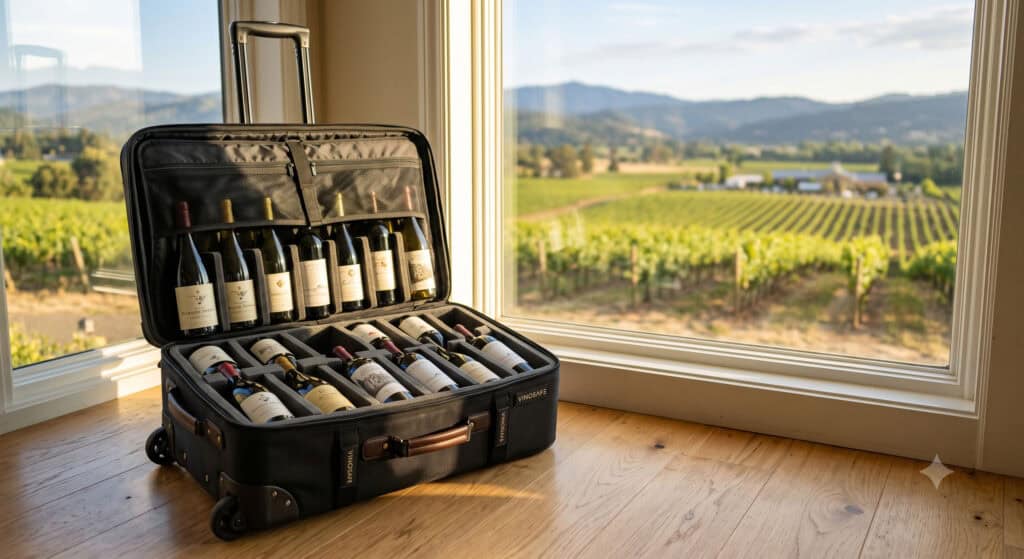
For most travelers bringing home somewhere close to a case, the best mix of cost, control, and peace of mind is a reusable wine travel case, like The Wine Check, checked at the airport like a normal bag. It wraps a standard wine shipper box in a padded rolling shell, so you skip the shipping wait and keep your bottles with you the whole trip.
That said, it’s not automatically the right call for everyone. Depending on how many bottles you’re hauling, the season, and where you live, one of these might work better:
- Winery-to-home shipping, simplest for a bottle or two, but pricier per bottle and paused during extreme heat
- A licensed Napa wine shipping service, best when you’re consolidating purchases from several wineries into one box
- A dedicated wine suitcase, more upfront cost, but better protection if you’re not checking a full case
Here’s how to figure out which one actually fits your trip.
Option 1: Fly with your wine as checked baggage
If you’re bringing home somewhere between 6 and 12 bottles, checking wine as regular luggage is often the sweet spot. You avoid paying shipping fees at every winery you visited, and you don’t have to wait a week wondering if a box survived a delivery truck in July.
A reusable case like The Wine Check exists specifically for this: it encloses a standard 12-bottle wine shipper box inside a padded rolling shell, weighs about 3.3 lbs empty, and is built to keep a full case closer to common airline weight limits. Once it folds flat, it stores inside another suitcase for next time, useful if you’re also working out getting around Napa Valley logistics for the return trip.
Check current baggage fees before you pack a case
Baggage pricing has changed more than once in the past year, so don’t trust an old blog post, including, frankly, ones like this from a few months back. As of the April 2026 fee update, Southwest charges $45 for a first checked bag and $55 for a second on Basic, Choice, and Choice Preferred fares, with overweight charges of $100 for bags between 51 and 70 lbs and $200 for 71 to 100 lbs. A well-packed case of wine typically lands in the 40 to 45 lb range, so weigh it before you leave the hotel, a shipping store or hotel front desk scale can save you an ugly surprise at the counter.
Flying Alaska? Your case might check for free
If you’re departing on Alaska Airlines from one of its West Coast markets, join Atmos Rewards (it’s free) and add your number to the reservation. Members can check one case of wine, up to 12 bottles, 50 lbs or less, properly packed, without it counting toward checked baggage. It has to go through the ticket counter with an agent, not a self-service kiosk, so build a few extra minutes into your airport timing.
One more limit worth knowing if you also picked up anything stronger than table wine: the TSA caps alcohol between 24% and 70% ABV at 5 liters per passenger in checked bags, and it has to be in unopened retail packaging. Standard Napa wine sits well under that threshold, but a fortified port or a barrel-proof spirit you grabbed on a whim might not.
Option 2: Let the winery ship it for you
Most Napa wineries can ship straight to your front door, and it’s genuinely the easiest option if you’re only walking away with a bottle or two, or if you’re already receiving a wine club allocation. You hand over your address, they handle the rest.
The catch: shipping isn’t always available on demand. Plenty of wineries pause direct shipping during the hottest weeks of summer or a hard winter freeze, because standard ground carriers don’t guarantee temperature-controlled handling the whole way. Rather than risk a shipment arriving cooked or frozen, they’d rather you wait a few weeks, or use a shipper built for it, which is where option three comes in.
The other downside is cost creep: pay for packing and shipping at four or five stops across a long weekend of winery tastings, and those small fees add up fast.
Option 3: Hire a licensed Napa wine shipping service
If you bought wine at several wineries, a local shipping service can consolidate everything into one box, arrange pickup from wherever you’re staying, and ship it under proper alcohol licensing, something you can’t legally do yourself.
This isn’t optional red tape, it’s federal and carrier policy. USPS prohibits mailing beer, wine, and liquor outright, with no consumer exception. FedEx and UPS will carry wine, but only for businesses that hold an alcohol shipping license and a signed carrier agreement, an individual traveler can’t walk in and ship a case under their own name.
That’s what licensed local shippers are for. A few worth knowing in the Napa Valley area:
- Buffalo’s Shipping Post (downtown Napa) — packing and shipping wine since the early 1990s, with pickup available and insurance around $3 per $100 of value; closed Sundays
- All American Mail Center (Trancas Street, Napa) — a full-service shipper since 1985 running a dedicated wine shipping and fulfillment side of the business, with free Napa Valley pickup for club and bulk orders
- Bodega Shipping Co. (St. Helena) — free pickup within Napa Valley, temperature-control options, and roughly $2 per $100 in declared value for insurance; closed weekends
- Stagecoach Express (Napa) — wine-focused shipping with cold-pack and insurance options for hot-weather trips
Call ahead on weekends since most of these close Saturday or Sunday, and ask about temperature-managed shipping if you’re traveling in peak summer or if the package will sit on a porch before anyone’s home.
Can you even ship wine to your state? Ask before you buy
Direct-to-consumer wine shipping law is genuinely messy, and it depends on whether the shipper is the winery itself, a retailer, or a fulfillment house, plus permit requirements, quantity caps, and adult-signature rules that vary state by state. States also update these rules more often than you’d expect.
Skip the research rabbit hole and just ask at the tasting room counter: “Can you ship to my home state, and if not, who’s the best local shipper to use instead?” The same staff who can walk you through how to taste wine like a local deal with this question daily, and know the current answer faster than any article can.
Which method fits how much wine you’re bringing home
The right call mostly comes down to bottle count and your overall trip budget.
- 1 to 3 bottles: pack them in bottle-protector sleeves inside your suitcase, cushioned with clothing, or just let the winery ship them
- 4 to 8 bottles: sleeves and careful packing still work, but lean toward a licensed shipper if it’s peak summer or winter heat/cold
- 9 to 12 bottles: this is where a case-based solution, The Wine Check or a dedicated wine suitcase, earns its keep, or consolidate everything through one Napa shipper
- More than a case: consolidate with a shipping service and ask about a short storage hold if the forecast looks brutal
Protecting your wine from heat, cold, and rough handling
Whichever method you pick, four enemies threaten every bottle: heat, freezing cold, direct UV light, and rough handling in transit. Napa summers regularly push past 95 degrees, so this deserves a real plan, not an afterthought.
A few habits go a long way: never leave bottles sitting in a hot trunk between winery stops, keep them out of direct sunlight on the dashboard or back seat, and bring a soft cooler or insulated tote if you’re hopping between several tasting rooms in one day. If you’re shipping rather than flying with your wine, try to send it early in the week so it isn’t sitting in a delivery truck or on a porch over a weekend.
FAQ: shipping and bringing home wine from Napa Valley
Is checking a case of wine cheaper than shipping it?
Usually, yes, if you’re already checking a bag anyway, a single bag fee typically beats shipping charges plus packing fees and insurance for a full case. The math flips if you’re buying from four or five wineries, where consolidated shipping can beat paying separate packing fees at each stop.
What happens if my winery won’t ship during the summer?
Ask if they offer a hold-and-ship option once temperatures drop, or bring your bottles home with you instead using a wine travel case. A local licensed shipper with temperature control is usually the fastest fallback if you’d rather not carry it yourself.
Can I just mail wine through USPS if it’s just a bottle or two?
No. USPS prohibits shipping alcohol entirely, regardless of quantity. That rule applies to a single bottle the same way it applies to a full case.
How much should I expect to pay for a good bottle in Napa?
Plenty of memorable bottles fall in the $30 to $75 range, with special-occasion pours well above that. Price mostly signals scarcity or prestige, not how much you’ll enjoy it, buy what you loved at the tasting.
Does the vintage on the bottle actually matter?
For most visitors, not much, vintage matters more if you’re building a cellar or chasing a specific style. The exception: if you fall hard for a bottle, grab a few from the same vintage so you can recreate that exact experience later.
What’s the safest way to pack wine inside a regular suitcase?
Use padded bottle sleeves or inflatable bottle protectors, then bury the bottles in the center of your suitcase surrounded by clothing on every side. Skip the outer edges and corners, since that’s where checked bags absorb the most impact.
However you get your wine home, the goal is the same: open that bottle back on your own couch, tell the story of where you found it, and start planning your next trip back to Napa Valley to do it all over again.